Enhance Labdrag the slider
© Enhance Lab
on Samsung Galaxy S25
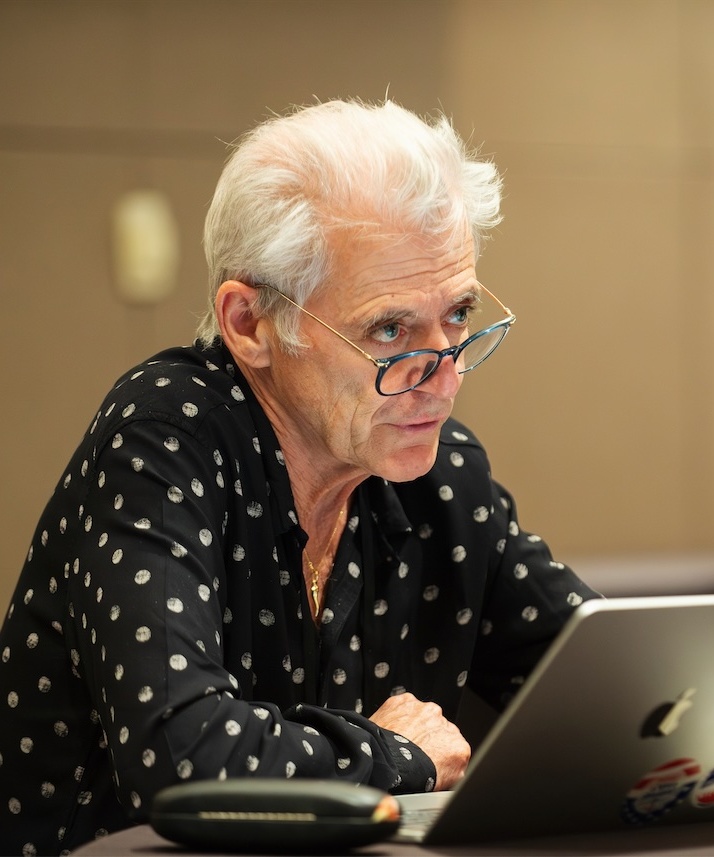 © Jean Ponce
ENS-PSL · New York University · Enhance Lab · PRAIRIE




Jean Ponce is a Professor at Ecole Normale Supérieure - PSL, where he served as Director of the Computer Science Department from 2011 to 2017, and a Global Distinguished Professor at the Courant Institute School of Mathematics, Computing, and Data Science of New York University. He is also the co-founder and CEO of Enhance Lab, a startup that commercializes embedded software for photo and video denoising and super-resolution. Jean Ponce is an IEEE, ELLIS and AAIS Fellow, a member of the Academia Europaea, and was a Sr. member of the Institut Universitaire de France. He has served as Program and/or General Chair of all three top international Computer Vision Conferences, CVPR (1997 and 2000), ECCV (2008) and ICCV (2023), and as Sr. Editor-in-Chief of the International Journal of Computer Vision. He currently serves as Associate Director for Research of the PR[AI]RIE-PSAI AI Cluster. Jean Ponce is the recipient of two US patents and a French one, an ERC advanced grant, the 2016 and 2020 IEEE CVPR Longuet-Higgins prizes, and the 2019 ICML test-of-time award. He is the author of “Computer Vision: A Modern Approach”, a textbook translated in Chinese, Japanese, and Russian.
Email: jean.ponce (at) ens.fr
Embedded software for photo and video denoising and super-resolution from RAW image sequences.
A preview of each project, with a link to its page.
V. Herfeld, E. Coupeté, J. Mairal, J. Ponce. Learned sub-pixel trajectories and splatting turn temporal interpolation and multi-frame super-resolution into one operation, up to an order of magnitude faster.
vinceherfeld.github.io/residual-motion-splatting-for-CSTVSR ↗G. Lenain, E. Boyer, J. Ponce. A 1-Lipschitz implicit field fitted to sensor rays via sphere tracing: each ray certifies free space, giving robustness to noise and outliers.
gabriellenain.github.io/visibility-recon ↗Selected from my publication records. Complete and up-to-date list on Google Scholar. Earlier work: publications before 2006.
Preprints and venues for 2022–2026 are compiled from public indexes (arXiv, DBLP, OpenReview, IEEE Xplore) and may be incomplete.